Developers - API
The NiPreps community and contributing guidelines
PETPrep is a NiPreps application, and abides by the NiPreps Community guidelines. Please, make sure you have read and understood all the documentation provided in the NiPreps portal before you get started.
Setting up your development environment
We believe that PETPrep must be free to use, inspect, and critique. Correspondingly, you should be free to modify our software to improve it or adapt it to new use cases and we especially welcome contributions to improve it or its documentation.
We actively direct efforts into making the scrutiny and improvement processes as easy as possible. As part of such efforts, we maintain some tips and guidelines for developers to help minimize your burden if you want to modify the software.
Internal configuration system
A Python module to maintain unique, run-wide PETPrep settings.
This module implements the memory structures to keep a consistent, singleton config.
Settings are passed across processes via filesystem, and a copy of the settings for
each run and subject is left under
<petprep_dir>/sub-<participant_id>/log/<run_unique_id>/petprep.toml.
Settings are stored using ToML.
The module has a to_filename() function to allow writing out
the settings to hard disk in ToML format, which looks like:
[environment]
cpu_count = 8
exec_env = "posix"
free_mem = 2.2
overcommit_policy = "heuristic"
overcommit_limit = "50%"
nipype_version = "1.5.0"
templateflow_version = "0.4.2"
version = "0.0.1"

[execution]
bids_dir = "pet/"
bids_description_hash = "5d42e27751bbc884eca87cb4e62b9a0cca0cd86f8e578747fe89b77e6c5b21e5"
boilerplate_only = false
fs_license_file = "/opt/freesurfer/license.txt"
fs_subjects_dir = "/opt/freesurfer/subjects"
log_dir = "/home/oesteban/tmp/petprep-ds005/out/petprep/logs"
log_level = 40
low_mem = false
md_only_boilerplate = false
notrack = true
output_dir = "/tmp"
output_spaces = "MNI152NLin2009cAsym:res-2 MNI152NLin2009cAsym:res-native fsaverage:den-10k fsaverage:den-30k"
reports_only = false
run_uuid = "20200306-105302_d365772b-fd60-4741-a722-372c2f558b50"
participant_label = [ "01",]
processing_groups = [ "sub-01",]
templateflow_home = "~/.cache/templateflow"
work_dir = "work/"
write_graph = false

[workflow]
anat_only = false
aroma_err_on_warn = false
aroma_melodic_dim = -200
pet2anat_dof = 6
pet2anat_init = "auto"
fmap_bspline = false
force = []
force_syn = false
hires = false
ignore = []
longitudinal = false
medial_surface_nan = false
project_goodvoxels = false
regressors_all_comps = false
regressors_dvars_th = 1.5
regressors_fd_th = 0.5
run_reconall = true
skull_strip_fixed_seed = false
skull_strip_template = "OASIS30ANTs"
subject_anatomical_reference = "first-lex"
t2s_coreg = false
use_aroma = false

[nipype]
crashfile_format = "txt"
get_linked_libs = false
memory_gb = 32
nprocs = 8
omp_nthreads = 8
plugin = "MultiProc"
resource_monitor = false
stop_on_first_crash = false

[nipype.plugin_args]
maxtasksperchild = 1
raise_insufficient = false

[execution.bids_filters.t1w]
reconstruction = "<Query.NONE: 1>"

[execution.bids_filters.t2w]
reconstruction = "<Query.NONE: 1>"
This config file is used to pass the settings across processes,
using the load() function.
Configuration sections
- class petprep.config.environment[source]
Read-only options regarding the platform and environment.
Crawls runtime descriptive settings (e.g., default FreeSurfer license, execution environment, nipype and PETPrep versions, etc.). The
environmentsection is not loaded in from file, only written out when settings are exported. This config section is useful when reporting issues, and these variables are tracked whenever the user does not opt-out using the--notrackargument.- cpu_count = 2
Number of available CPUs.
- exec_docker_version = None
Version of Docker Engine.
- exec_env = 'posix'
A string representing the execution platform.
- free_mem = 6.1
Free memory at start.
- nipype_version = '1.11.0'
Nipype’s current version.
- overcommit_limit = '50%'
Linux’s kernel virtual memory overcommit limits.
- overcommit_policy = 'heuristic'
Linux’s kernel virtual memory overcommit policy.
- templateflow_version = '25.1.2'
The TemplateFlow client version installed.
- version = '0.0.9.dev65+g37c5266'
PETPrep’s version.
- class petprep.config.execution[source]
Configure run-level settings.
- aggr_ses_reports = None
Maximum number of sessions aggregated in one subject’s visual report.
- bids_database_dir = None
Path to the directory containing SQLite database indices for the input BIDS dataset.
- bids_description_hash = None
Checksum (SHA256) of the
dataset_description.jsonof the BIDS dataset.
- bids_dir = None
An existing path to the dataset, which must be BIDS-compliant.
- bids_filters = None
A dictionary of BIDS selection filters.
- boilerplate_only = False
Only generate a boilerplate.
- combine_runs = False
Combine multiple runs for each PET series before preprocessing.
- country_code = 'CAN'
Country ISO code used by carbon trackers.
- dataset_links = {}
A dictionary of dataset links to be used to track Sources in sidecars.
- debug = []
Debug mode(s).
- derivatives = {}
Path(s) to search for pre-computed derivatives
- fs_license_file = None
An existing file containing a FreeSurfer license.
- fs_subjects_dir = None
FreeSurfer’s subjects directory.
- layout = None
A
BIDSLayoutobject, seeinit().
- log_dir = None
The path to a directory that contains execution logs.
- log_level = 25
Output verbosity.
- low_mem = None
Utilize uncompressed NIfTIs and other tricks to minimize memory allocation.
- md_only_boilerplate = False
Do not convert boilerplate from MarkDown to LaTex and HTML.
- notrack = False
Do not collect telemetry information for PETPrep.
- output_dir = None
Folder where derivatives will be stored.
- output_layout = None
Layout of derivatives within output_dir.
- output_spaces = None
List of (non)standard spaces designated (with the
--output-spacesflag of the command line) as spatial references for outputs.
- participant_label = None
List of participant identifiers that are to be preprocessed.
- petprep_dir = None
Root of PETPrep BIDS Derivatives dataset. Depends on output_layout.
- processing_groups = None
List of subject/session groups to preprocess.
- rec_label = None
List of reconstruction identifiers that are to be preprocessed.
- reports_only = False
Only build the reports, based on the reportlets found in a cached working directory.
- run_label = None
List of run identifiers that are to be preprocessed.
- run_uuid = '20260716-145338_47680523-e188-4cb6-b836-5e0d55822e06'
Unique identifier of this particular run.
- session_label = None
List of session identifiers that are to be preprocessed.
- sloppy = False
Run in sloppy mode (meaning, suboptimal parameters that minimize run-time).
- task_id = None
Select a particular task from all available in the dataset.
- templateflow_home = PosixPath('/home/docs/.cache/templateflow')[source]
The root folder of the TemplateFlow client.
- tracer_label = None
List of tracer identifiers that are to be preprocessed.
- track_carbon = False
Tracks power draws using CodeCarbon package.
- work_dir = PosixPath('/home/docs/checkouts/readthedocs.org/user_builds/petprep/checkouts/latest/docs/work')[source]
Path to a working directory where intermediate results will be available.
- write_graph = False
Write out the computational graph corresponding to the planned preprocessing.
- class petprep.config.workflow[source]
Configure the particular execution graph of this workflow.
- anat_only = False
Execute the anatomical preprocessing only.
- cifti_output = None
Generate HCP Grayordinates, accepts either
'91k'(default) or'170k'.
- force = None
Force particular steps for PETPrep.
- fs_no_resume = None
Adjust pipeline to reuse base template of existing longitudinal freesurfer
- hires = False
Allow FreeSurfer
recon-allto use the-hiresflag for submillimeter T1w.
- hmc_init_frame: int | str | None = 'auto'
Index of initial frame for head-motion estimation (‘auto’ selects highest uptake).
- ignore = None
Ignore particular steps for PETPrep.
- level = None
Level of preprocessing to complete. One of [‘minimal’, ‘resampling’, ‘full’].
- longitudinal = False
Deprecated alias for
subject_anatomical_reference == 'unbiased'.
- medial_surface_nan = None
Fill medial surface with NaNs when sampling.
- pet2anat_crop_fallback: bool = True
Try uncropped anatomical registration when auto-mode cropped registration scores poorly.
- pet2anat_crop_fallback_threshold: float = -0.05
Similarity threshold for triggering uncropped anatomical registration fallback.
- pet2anat_dof = None
Degrees of freedom of the PET-to-anatomical registration steps.
- pet2anat_init = 'auto'
Initial transform for PET-to-anatomical registration.
- pet2anat_method: str = 'auto'
PET-to-anatomical registration method (mri_coreg, robust, ants, or auto).
- pet2anat_method_specified: bool = False
Flag indicating whether
--pet2anat-methodwas explicitly provided.
- petref: str = 'auto'
Strategy for building the PET reference (
'template','twa','sum','first5min'or'auto').
- project_goodvoxels = False
Exclude voxels with locally high coefficient of variation from sampling.
- regressors_all_comps = None
Return all CompCor components.
- regressors_dvars_th = None
Threshold for DVARS.
- regressors_fd_th = None
Threshold for FD.
- run_msmsulc = True
Run Multimodal Surface Matching surface registration.
- run_reconall = True
Run FreeSurfer’s surface reconstruction.
- seg = 'gtm'
Segmentation approach (‘gtm’, ‘brainstem’, ‘thalamicNuclei’, ‘hippocampusAmygdala’, ‘wm’, ‘aparcaseg’, ‘raphe’, ‘limbic’).
- skull_strip_fixed_seed = False
Fix a seed for skull-stripping.
- skull_strip_t1w = 'force'
Skip brain extraction of the T1w image (default is
force, meaning that PETPrep will run brain extraction of the T1w).
- skull_strip_template = 'OASIS30ANTs'
Change default brain extraction template.
- spaces = None
Keeps the
SpatialReferencesinstance keeping standard and nonstandard spaces.
- subject_anatomical_reference = 'first-lex'
Method to produce the subject anatomical reference.
- class petprep.config.nipype[source]
Nipype settings.
- crashfile_format = 'txt'
The file format for crashfiles, either text (txt) or pickle (pklz).
- get_linked_libs = False
Run NiPype’s tool to enlist linked libraries for every interface.
- memory_gb = None
Estimation in GB of the RAM this workflow can allocate at any given time.
- nprocs = 2
Number of processes (compute tasks) that can be run in parallel (multiprocessing only).
- omp_nthreads = None
Number of CPUs a single process can access for multithreaded execution.
- plugin = 'MultiProc'
NiPype’s execution plugin.
- plugin_args = {'maxtasksperchild': 1, 'raise_insufficient': False}
Settings for NiPype’s execution plugin.
- remove_unnecessary_outputs = True
Clean up unused outputs after running
- resource_monitor = False
Enable resource monitor.
- stop_on_first_crash = True
Whether the workflow should stop or continue after the first error.
Usage
A config file is used to pass settings and collect information as the execution graph is built across processes.
from petprep import config
config_file = config.execution.work_dir / '.petprep.toml'
config.to_filename(config_file)
# Call build_workflow(config_file, retval) in a subprocess
with Manager() as mgr:
    from .workflow import build_workflow
    retval = mgr.dict()
    p = Process(target=build_workflow, args=(str(config_file), retval))
    p.start()
    p.join()
config.load(config_file)
# Access configs from any code section as:
value = config.section.setting
Logging
Other responsibilities
The config is responsible for other conveniency actions.
Switching Python’s
multiprocessingto forkserver mode.Set up a filter for warnings as early as possible.
Automated I/O magic operations. Some conversions need to happen in the store/load processes (e.g., from/to
Path<->str,BIDSLayout, etc.)
- petprep.config.from_dict(settings, init=True, ignore=None)[source]
Read settings from a flat dictionary.
- petprep.config.load(filename, skip=None, init=True)[source]
Load settings from file.
- Parameters:
filename (
os.PathLike) – TOML file containing PETPrep configuration.skip (dict or None) – Sets of values to ignore during load, keyed by section name
init (bool or
Container) – Initialize all, none, or a subset of configurations.
Workflows
PETPrep base processing workflows
- petprep.workflows.base.init_petprep_wf()[source]
Build PETPrep’s pipeline.
This workflow organizes the execution of PETPREP, with a sub-workflow for each subject.
If FreeSurfer’s
recon-allis to be run, a corresponding folder is created and populated with any needed template subjects under the derivatives folder.- Workflow Graph
- petprep.workflows.base.init_single_subject_wf(subject_id: str, session_id: str | list[str] | None = None)[source]
Organize the preprocessing pipeline for a single subject.
It collects and reports information about the subject, and prepares sub-workflows to perform anatomical and PET preprocessing. Anatomical preprocessing is performed in a single workflow, regardless of the number of sessions. Functional preprocessing is performed using a separate workflow for each individual PET series.
- Workflow Graph
Pre-processing PET workflows
Orchestrating the PET-preprocessing workflow
- petprep.workflows.pet.base.init_pet_wf(*, pet_series: list[str], precomputed: dict = None) Workflow[source]
This workflow controls the PET preprocessing stages of PETPrep.
- Workflow Graph
- Parameters:
pet_series – List of paths to NIfTI files.
precomputed – Dictionary containing precomputed derivatives to reuse, if possible.
- Inputs:
t1w_preproc – Bias-corrected structural template image
t1w_mask – Mask of the skull-stripped template image
t1w_dseg – Segmentation of preprocessed structural image, including gray-matter (GM), white-matter (WM) and cerebrospinal fluid (CSF)
t1w_tpms – List of tissue probability maps in T1w space
subjects_dir – FreeSurfer SUBJECTS_DIR
subject_id – FreeSurfer subject ID
fsnative2t1w_xfm – LTA-style affine matrix translating from FreeSurfer-conformed subject space to T1w
white – FreeSurfer white matter surfaces, in T1w space, collated left, then right
midthickness – FreeSurfer mid-thickness surfaces, in T1w space, collated left, then right
pial – FreeSurfer pial surfaces, in T1w space, collated left, then right
sphere_reg_fsLR – Registration spheres from fsnative to fsLR space, collated left, then right
anat_ribbon – Binary cortical ribbon mask in T1w space
segmentation – Segmentation file in T1w space
dseg_tsv – TSV with segmentation statistics
anat2std_xfm – Transform from anatomical space to standard space
std_t1w – T1w reference image in standard space
std_mask – Brain (binary) mask of the standard reference image
std_space – Value of space entity to be used in standard space output filenames
std_resolution – Value of resolution entity to be used in standard space output filenames
std_cohort – Value of cohort entity to be used in standard space output filenames
anat2mni6_xfm – Transform from anatomical space to MNI152NLin6Asym space
mni6_mask – Brain (binary) mask of the MNI152NLin6Asym reference image
mni2009c2anat_xfm – Transform from MNI152NLin2009cAsym to anatomical space
Note that ``anat2std_xfm``, ``std_space``, ``std_resolution``,
``std_cohort``, ``std_t1w`` and ``std_mask`` are treated as single
inputs. In order to resample to multiple target spaces, connect
these fields to an iterable.
See also
init_pet_fit_wf()init_pet_native_wf()init_pet_volumetric_resample_wf()init_ds_pet_native_wf()init_ds_volumes_wf()init_carpetplot_wf()
- petprep.workflows.pet.base.init_pet_fit_wf(*, pet_series: list[str], precomputed: dict = None, omp_nthreads: int = 1, name: str = 'pet_fit_wf') Workflow[source]
This workflow controls the fit-stage estimation steps for PET preprocessing.
- Workflow Graph
- Parameters:
pet_series – List of paths to NIfTI files
precomputed – Dictionary containing precomputed derivatives to reuse, if possible.
- Inputs:
pet_file – PET series NIfTI file
t1w_preproc – Bias-corrected structural template image
t1w_mask – Mask of the skull-stripped template image
t1w_dseg – Segmentation of preprocessed structural image, including gray-matter (GM), white-matter (WM) and cerebrospinal fluid (CSF)
anat2std_xfm – List of transform files, collated with templates
subjects_dir – FreeSurfer SUBJECTS_DIR
subject_id – FreeSurfer subject ID
fsnative2t1w_xfm – LTA-style affine matrix translating from FreeSurfer-conformed subject space to T1w
segmentation – Segmentation file in T1w space
dseg_tsv – TSV with segmentation statistics
- Outputs:
petref – PET reference image used for head motion correction.
pet_mask – Mask of
petref.motion_xfm – Affine transforms from each PET volume to
petref, written as concatenated ITK affine transforms.petref2anat_xfm – Affine transform mapping from PET reference space to the anatomical space.
registration_fallback – Whether the selected PET-to-anatomical registration used the uncropped anatomical fallback.
registration_anat_reference – Anatomical reference used by the selected PET-to-anatomical transform (
croppedoruncropped).
See also
init_ds_petref_wf()init_ds_hmc_wf()init_ds_registration_wf()
- petprep.workflows.pet.base.init_pet_native_wf(*, pet_series: list[str], omp_nthreads: int = 1, name: str = 'pet_native_wf') Workflow[source]
Minimal resampling workflow.
This workflow resamples the PET series into PET reference space while applying the head-motion transforms estimated in the fit stage. It also selects the transforms needed to perform further resampling.
- Workflow Graph
- Parameters:
pet_series – List of paths to NIfTI files.
- Inputs:
petref – PET reference file
pet_mask – Mask of pet reference file
motion_xfm – Affine transforms from each PET volume to
petref, written as concatenated ITK affine transforms.
- Outputs:
pet_minimal – PET series ready for further resampling.
pet_native – PET series resampled into PET reference space. Head motion correction will be applied to each file.
metadata – Metadata dictionary of PET series
motion_xfm – Motion correction transforms for further correcting pet_minimal.
Head-Motion Estimation and Correction (HMC) of PET images
- petprep.workflows.pet.hmc.init_pet_hmc_wf(mem_gb: float, omp_nthreads: int, *, fwhm: float = 10.0, start_time: float = 120.0, frame_durations: Sequence[float] | None = None, frame_start_times: Sequence[float] | None = None, initial_frame: int | str | None = 'auto', fixed_frame: bool = False, subsample_threshold: int | None = None, memory_policy: str = 'auto', name: str = 'pet_hmc_wf')[source]
Build a workflow to estimate head-motion parameters.
This workflow estimates the motion parameters to perform HMC over the input PET image.
- Workflow Graph
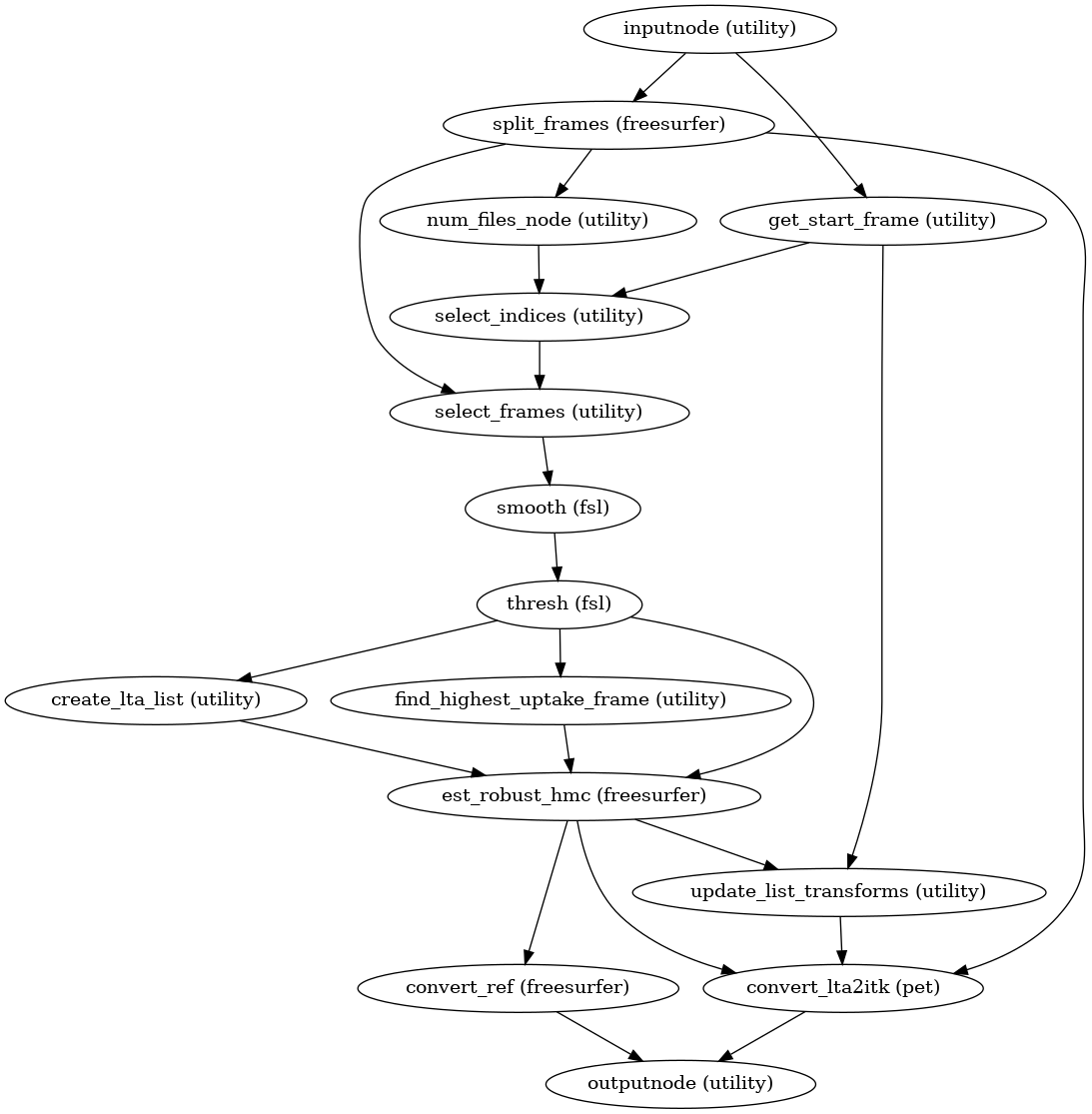
(Source code, png, svg, pdf)
- Parameters:
mem_gb (
float) – Size of PET file in GBomp_nthreads (
int) – Maximum number of threads an individual process may usefwhm (
float) – FWHM in millimeters for Gaussian smoothing prior to motion estimationstart_time (
float) – Earliest time point (in seconds) used for motion estimation.frame_durations (
Sequence[float] orNone) – Duration of each frame in seconds. If not provided, start-time clamping will be skipped.frame_start_times (
Sequence[float] orNone) – Optional list of frame onset times used together withframe_durationsto locate the start frame.initial_frame (
int,'auto'orNone) – 0-based index of the frame used to initialize motion correction. If'auto'orNone(default), the frame with the highest uptake is selected automatically. FreeSurfer’sinitial_timepointis 1-based; this workflow applies the required offset internally.fixed_frame (
bool) – Whether to keep the initial time point fixed during robust template estimation (fs.RobustTemplate’sfixtpparameter). IfTrue, iterations are skipped to reduce runtime.subsample_threshold (
intorNone) – FreeSurfermri_robust_template --subsamplethreshold. IfNone, robust-template subsampling is not requested.memory_policy ({‘auto’, ‘off’}) – Whether automatic HMC memory safeguards were enabled for this workflow.
name (
str) – Name of workflow (default:pet_hmc_wf)
- Inputs:
pet_file – PET series NIfTI file
frame_durations – Duration of each PET frame, in seconds.
frame_start_times – Optional onset time of each PET frame.
- Outputs:
xforms – ITKTransform file aligning each volume to
ref_imagepetref – PET reference image generated during motion estimation
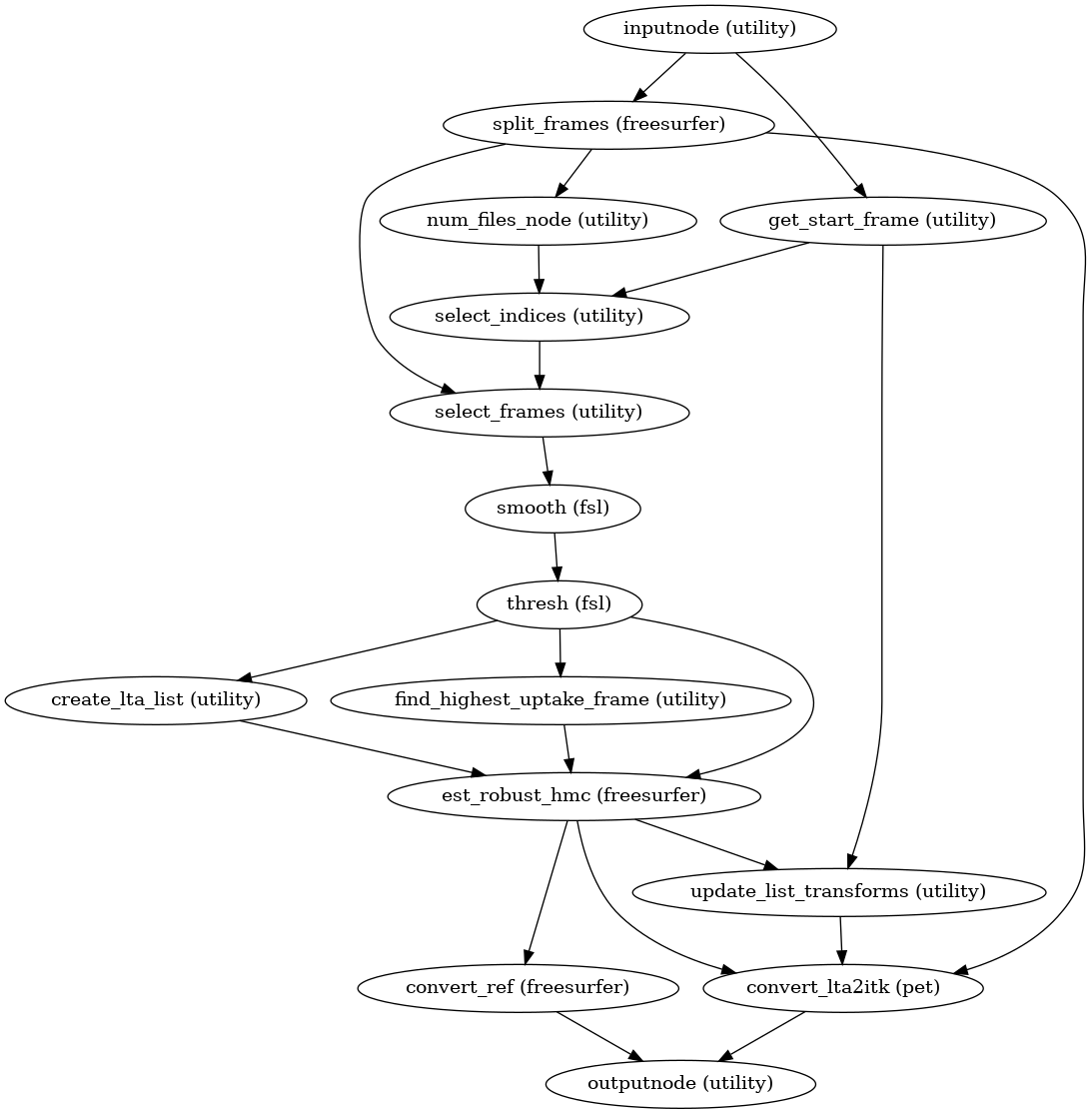
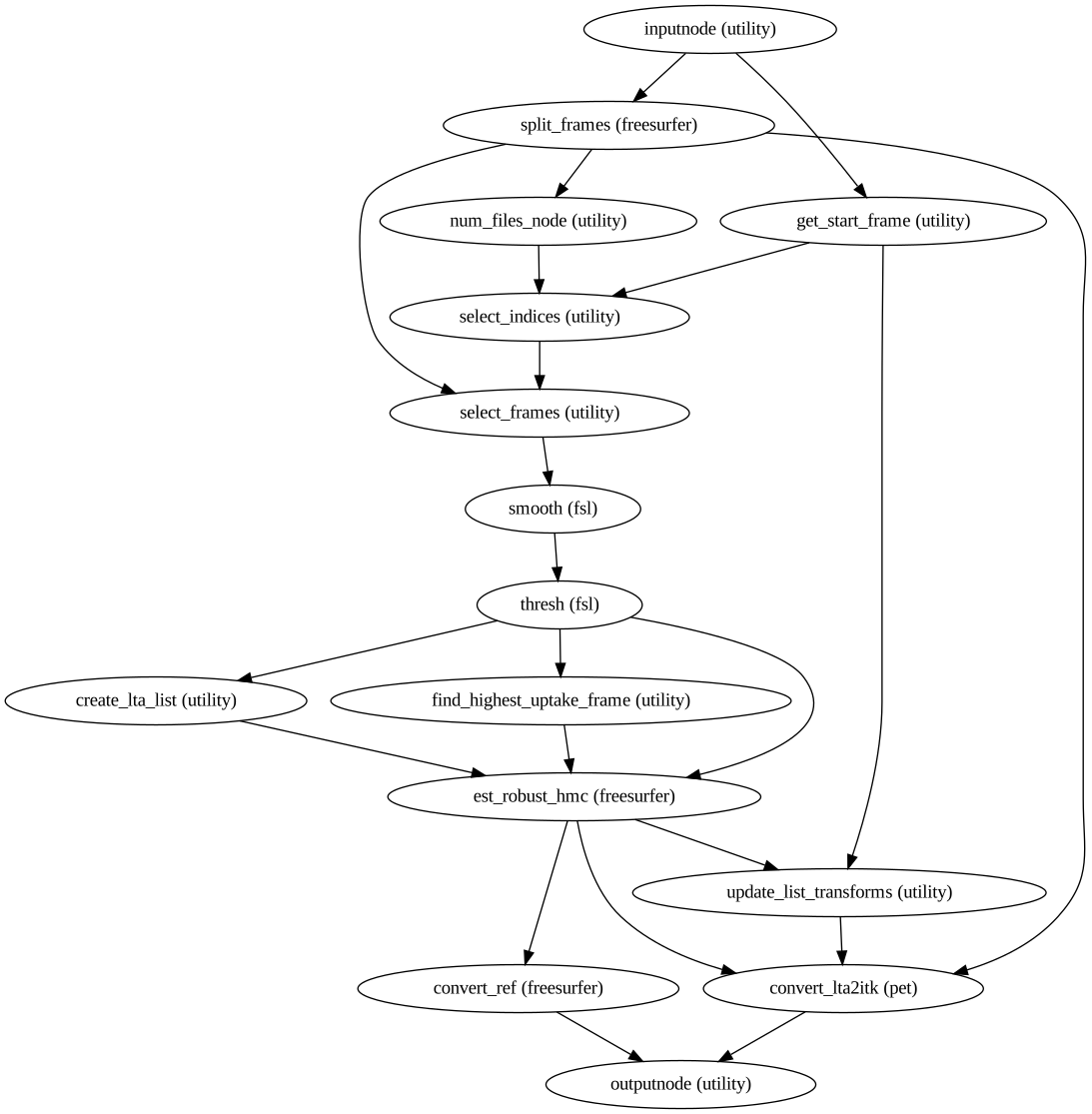
Registration workflows
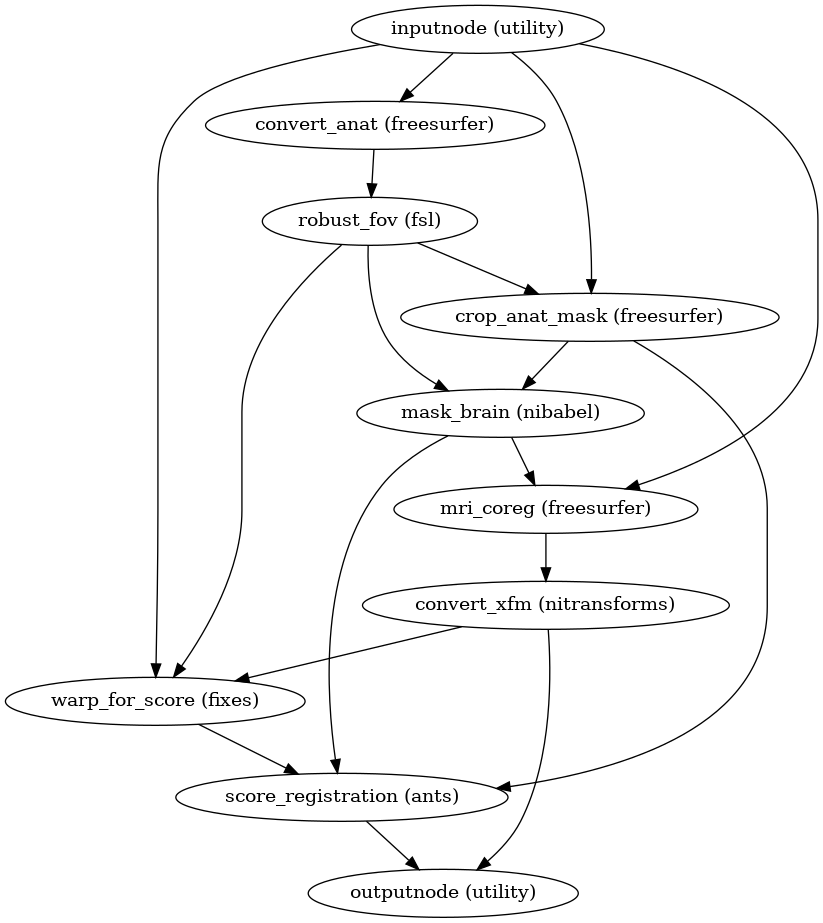
- petprep.workflows.pet.registration.init_pet_reg_wf(*, pet2anat_dof: Literal[6, 9, 12], mem_gb: float, omp_nthreads: int, pet2anat_method: str = 'mri_coreg', crop_anat: bool = True, name: str = 'pet_reg_wf', sloppy: bool = False)[source]
Build a workflow to run same-subject, PET-to-anat image-registration.
Calculates the registration between a reference PET image and anat-space.
- Workflow Graph
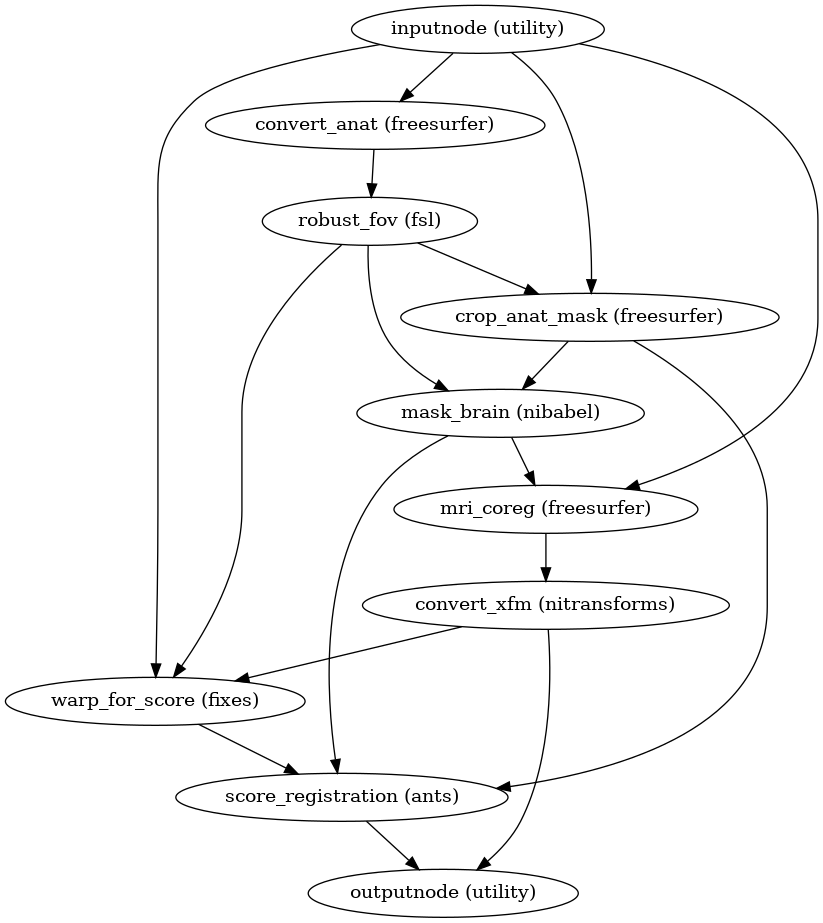
(Source code, png, svg, pdf)
- Parameters:
pet2anat_dof (6, 9 or 12) – Degrees-of-freedom for PET-anatomical registration
mem_gb (
float) – Size of PET file in GBomp_nthreads (
int) – Maximum number of threads an individual process may usepet2anat_method (
str) – Method for PET-to-anatomical registration. Options are ‘mri_coreg’ (default FreeSurfer co-registration), ‘robust’ (uses FreeSurfer mri_robust_register with NMI, 6 DoF only), ‘ants’ (uses ANTs rigid registration, 6 DoF only), or ‘auto’ (runs FreeSurfer and ANTs in parallel, selecting the best-performing transform).crop_anat (
bool) – Crop the anatomical reference with FSL’srobustfovbefore registration.name (
str) – Name of workflow (default:pet_reg_wf)
- Inputs:
ref_pet_brain – Reference image to which PET series is aligned If
fieldwarp == True,ref_pet_brainshould be unwarpedanat_preproc – Preprocessed anatomical image
anat_mask – Brainmask for anatomical image
- Outputs:
itk_pet_to_anat – Affine transform from
ref_pet_brainto anatomical space (ITK format)itk_anat_to_pet – Affine transform from anatomical space to PET space (ITK format)
registration_winner – Name of the registration backend selected when
pet2anat_method='auto'registration_score – Similarity score for the selected registration transform.
fallback – Whether this workflow output came from an uncropped anatomical fallback registration.
anat_reference – Anatomical reference used for registration (
croppedoruncropped).
Resampling workflows
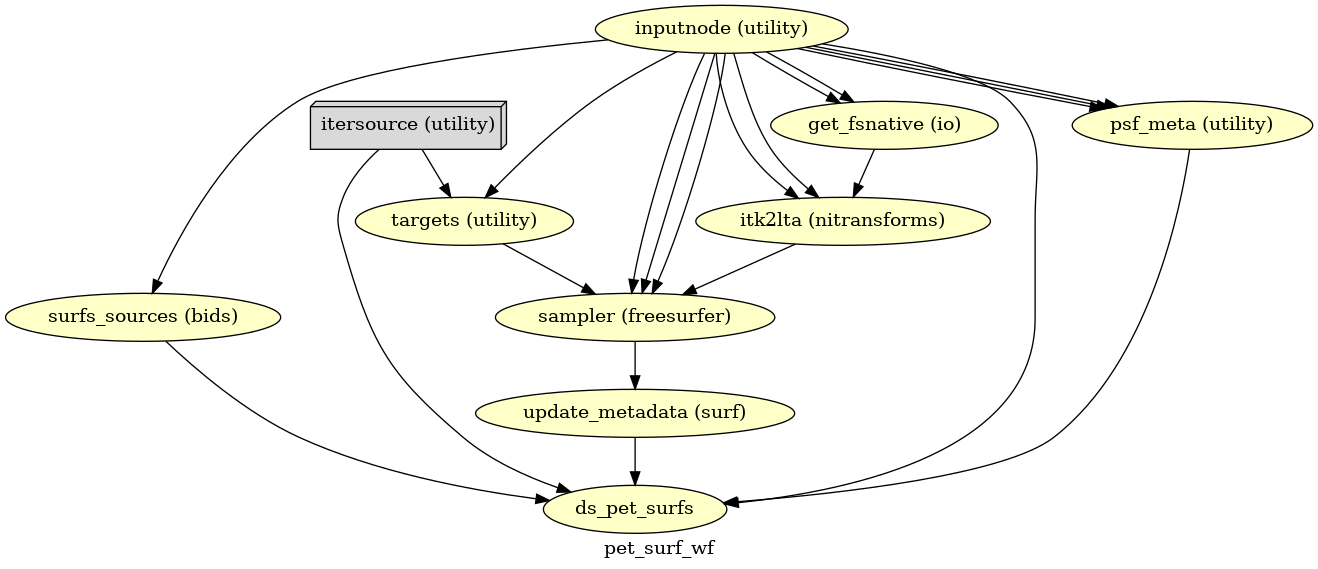
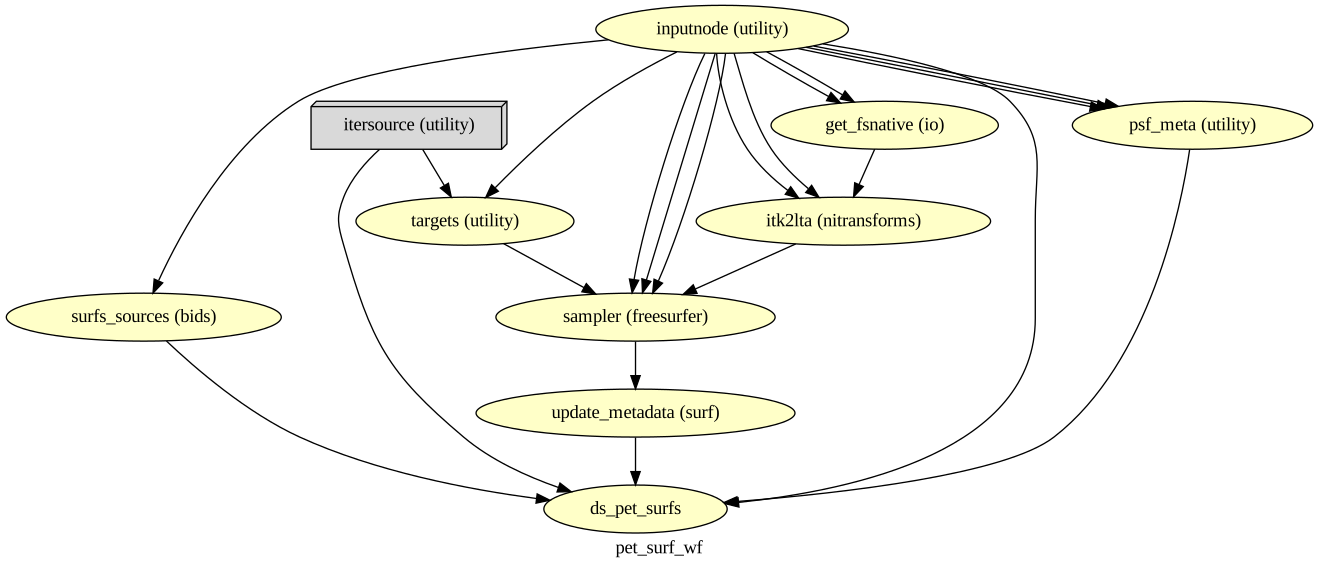
- petprep.workflows.pet.resampling.init_pet_surf_wf(*, mem_gb: float, surface_spaces: list[str], medial_surface_nan: bool, metadata: dict, output_dir: str, pvc_method: str | None = None, pvc_software_name: str | None = None, pvc_command_line: str | None = None, name: str = 'pet_surf_wf')[source]
Sample functional images to FreeSurfer surfaces.
For each vertex, the cortical ribbon is sampled at six points (spaced 20% of thickness apart) and averaged.
Outputs are in GIFTI format.
- Workflow Graph
(Source code, png, svg, pdf)
- Parameters:
surface_spaces (
list) – List of FreeSurfer surface-spaces (eitherfsaverage{3,4,5,6,}orfsnative) the functional images are to be resampled to. Forfsnative, images will be resampled to the individual subject’s native surface.medial_surface_nan (
bool) – Replace medial wall values with NaNs on functional GIFTI filespvc_method (
str, optional) – Name of the PVC method, if applied. Used to set thepvcBIDS entity on derivative files.
- Inputs:
source_file – Original PET series
sources – List of files used to create the output files.
pet_t1w – Motion-corrected PET series in T1 space
subjects_dir – FreeSurfer SUBJECTS_DIR
subject_id – FreeSurfer subject ID
fsnative2t1w_xfm – ITK-style affine matrix translating from FreeSurfer-conformed subject space to T1w
- Outputs:
surfaces – PET series, resampled to FreeSurfer surfaces
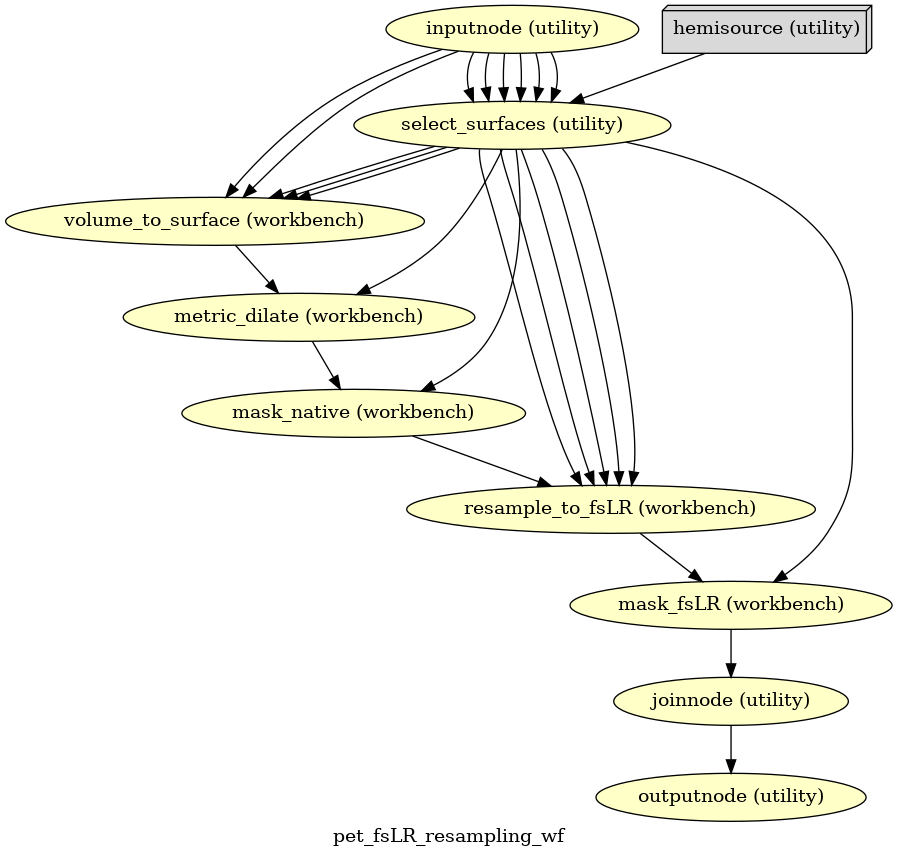
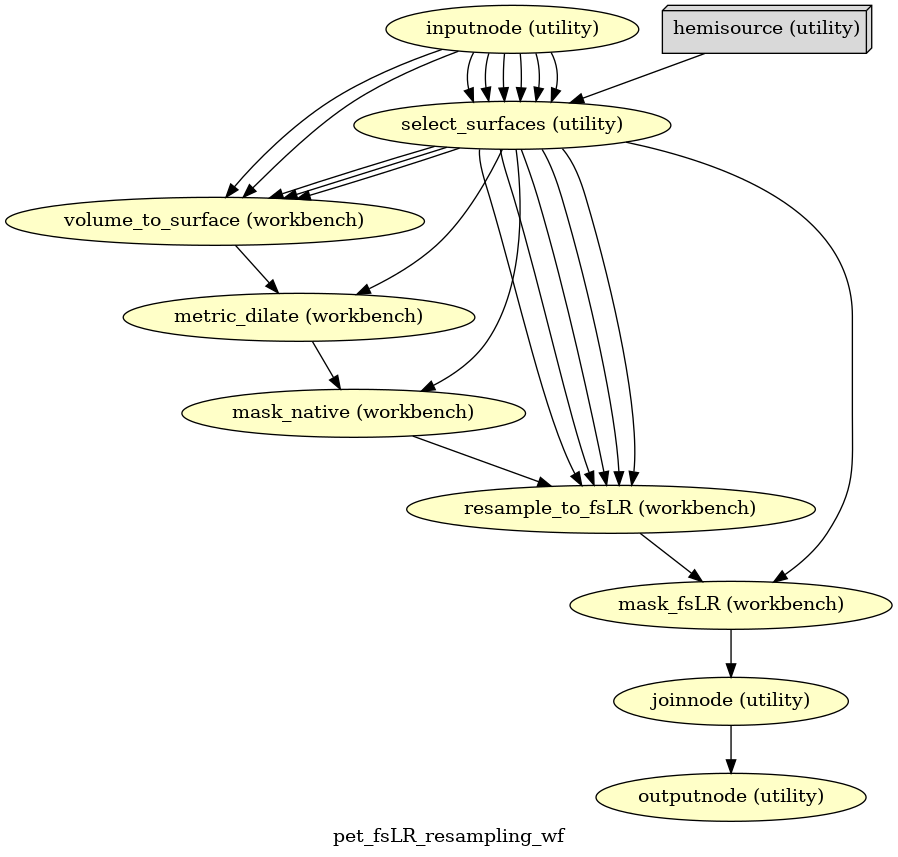
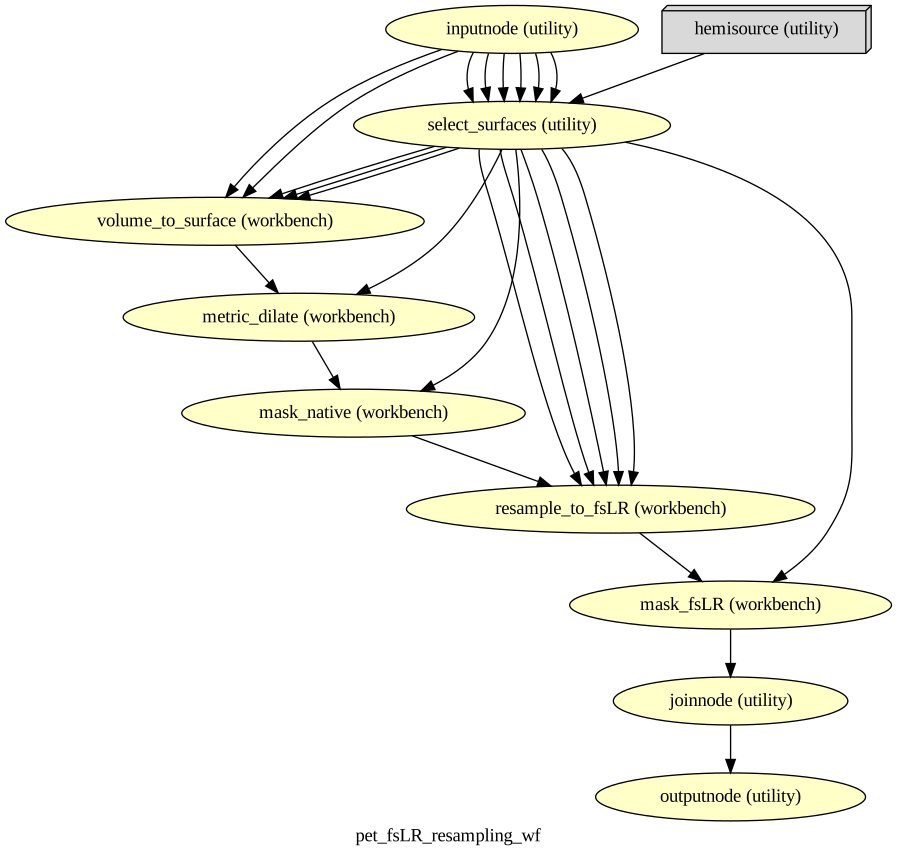
- petprep.workflows.pet.resampling.init_pet_fsLR_resampling_wf(grayord_density: Literal['91k', '170k'], omp_nthreads: int, mem_gb: float, name: str = 'pet_fsLR_resampling_wf')[source]
Resample PET time series to fsLR surface.
This workflow is derived heavily from three scripts within the DCAN-HCP pipelines scripts
Line numbers correspond to the locations of the code in the original scripts, found at: https://github.com/DCAN-Labs/DCAN-HCP/tree/9291324/
- Workflow Graph
(Source code, png, svg, pdf)
- Parameters:
- Inputs:
pet_file (
str) – Path to PET file resampled into T1 spacewhite (
listofstr) – Path to left and right hemisphere white matter GIFTI surfaces.pial (
listofstr) – Path to left and right hemisphere pial GIFTI surfaces.midthickness (
listofstr) – Path to left and right hemisphere midthickness GIFTI surfaces.midthickness_fsLR (
listofstr) – Path to left and right hemisphere midthickness GIFTI surfaces in fsLR space.sphere_reg_fsLR (
listofstr) – Path to left and right hemisphere sphere.reg GIFTI surfaces, mapping from subject to fsLRcortex_mask (
listofstr) – Path to left and right hemisphere cortical masks.volume_roi (
stror Undefined) – Pre-calculated mask. Not required.
- Outputs:
pet_fsLR (
listofstr) – Path to PET series resampled as functional GIFTI files in fsLR space
- petprep.workflows.pet.resampling.init_pet_grayords_wf(grayord_density: Literal['91k', '170k'], mem_gb: float, metadata: dict, name: str = 'pet_grayords_wf')[source]
Sample Grayordinates files onto the fsLR atlas.
Outputs are in CIFTI2 format.
- Workflow Graph
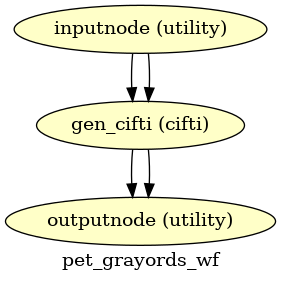
(Source code, png, svg, pdf)
- Parameters:
- Inputs:
- Outputs:
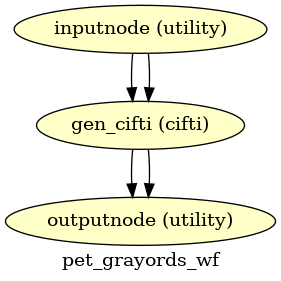
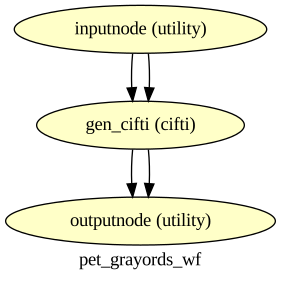
Calculate PET confounds
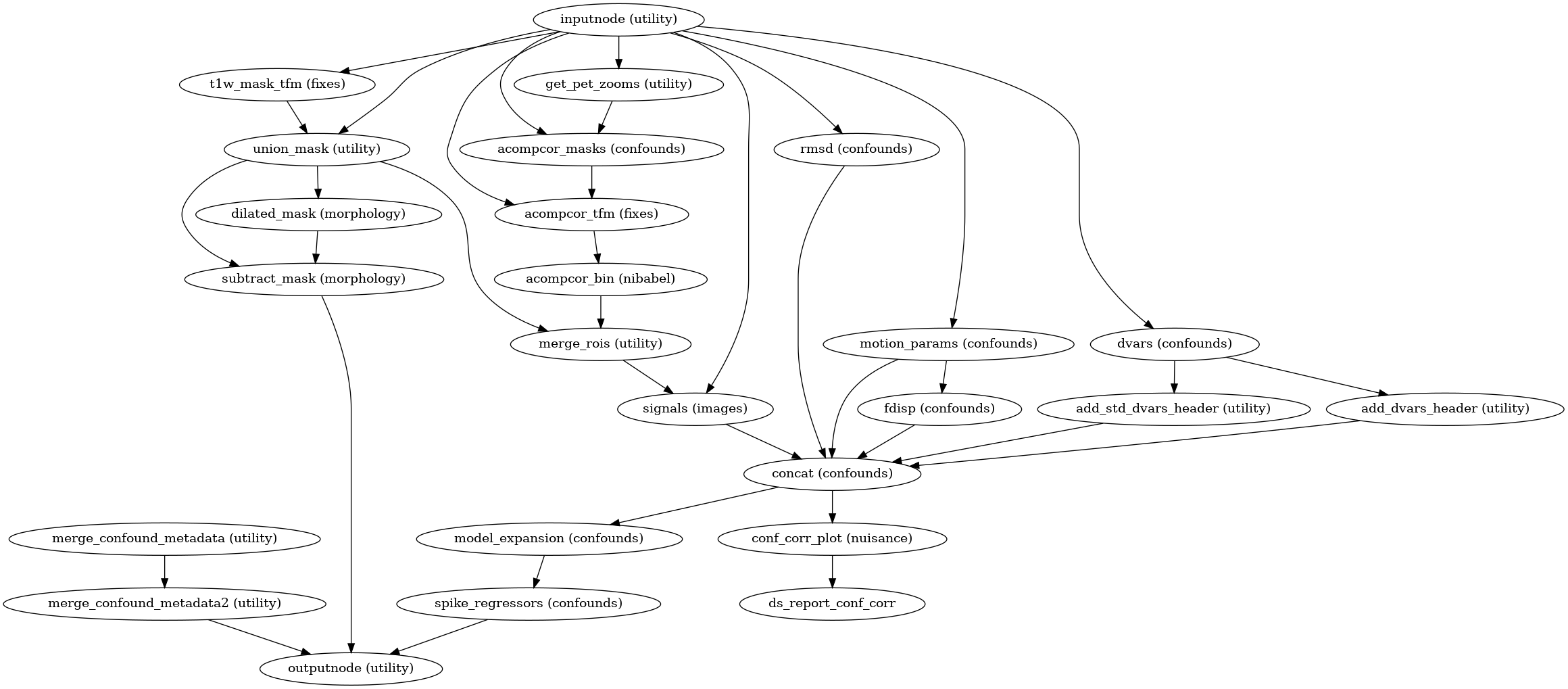
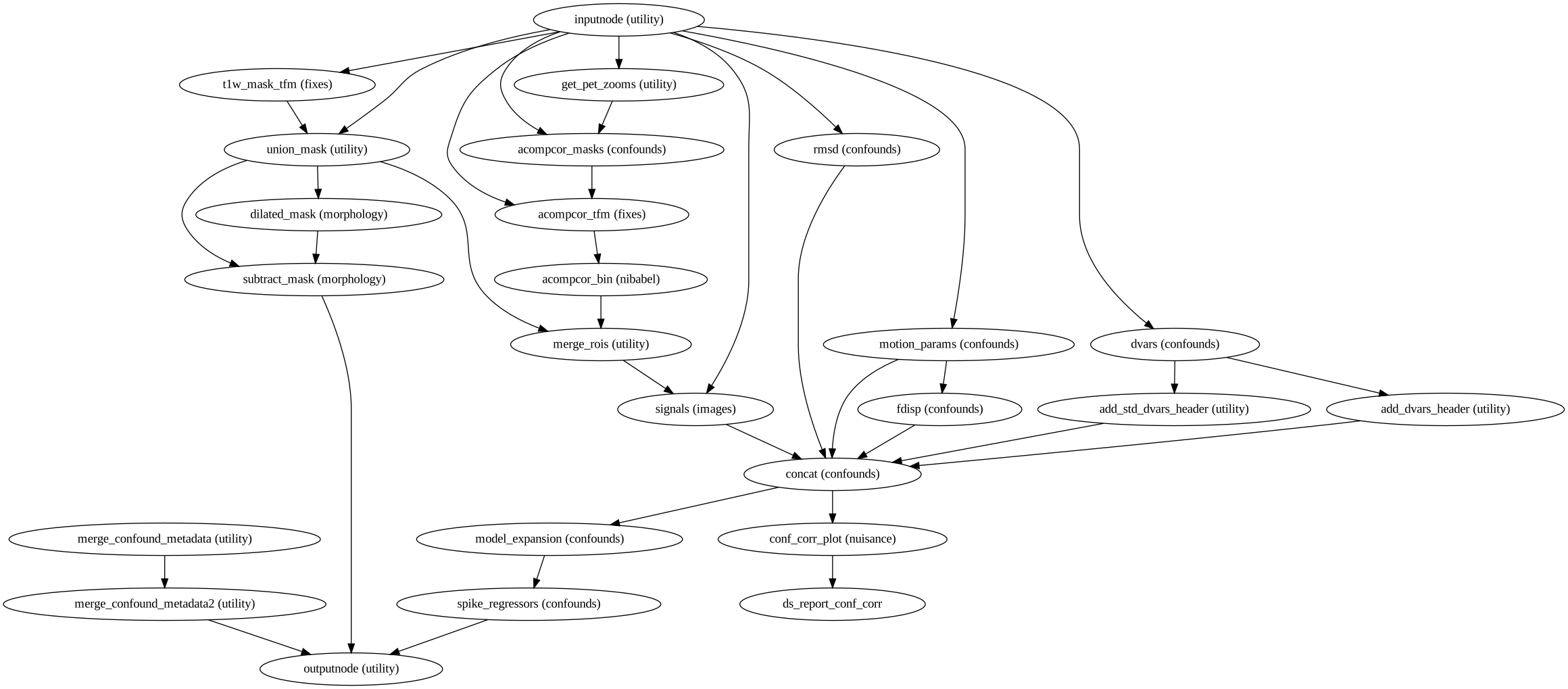
- petprep.workflows.pet.confounds.init_pet_confs_wf(mem_gb: float, regressors_dvars_th: float, regressors_fd_th: float, freesurfer: bool = False, name: str = 'pet_confs_wf')[source]
Build a workflow to generate and write out confounding signals.
This workflow calculates confounds for a PET series, and aggregates them into a TSV file, for use as nuisance regressors in a GLM. The following confounds are calculated, with column headings in parentheses:
Region-wise average signal (
csf,white_matter,global_signal)DVARS - original and standardized variants (
dvars,std_dvars)Framewise displacement, based on head-motion parameters (
framewise_displacement)Cosine basis set for high-pass filtering w/ 0.008 Hz cut-off (
cosine_XX)Non-steady-state volumes (
non_steady_state_XX)Estimated head-motion parameters, in mm and rad (
trans_x,trans_y,trans_z,rot_x,rot_y,rot_z)
Prior to estimating aCompCor and tCompCor, non-steady-state volumes are censored and high-pass filtered using a DCT basis. The cosine basis, as well as one regressor per censored volume, are included for convenience.
- Workflow Graph
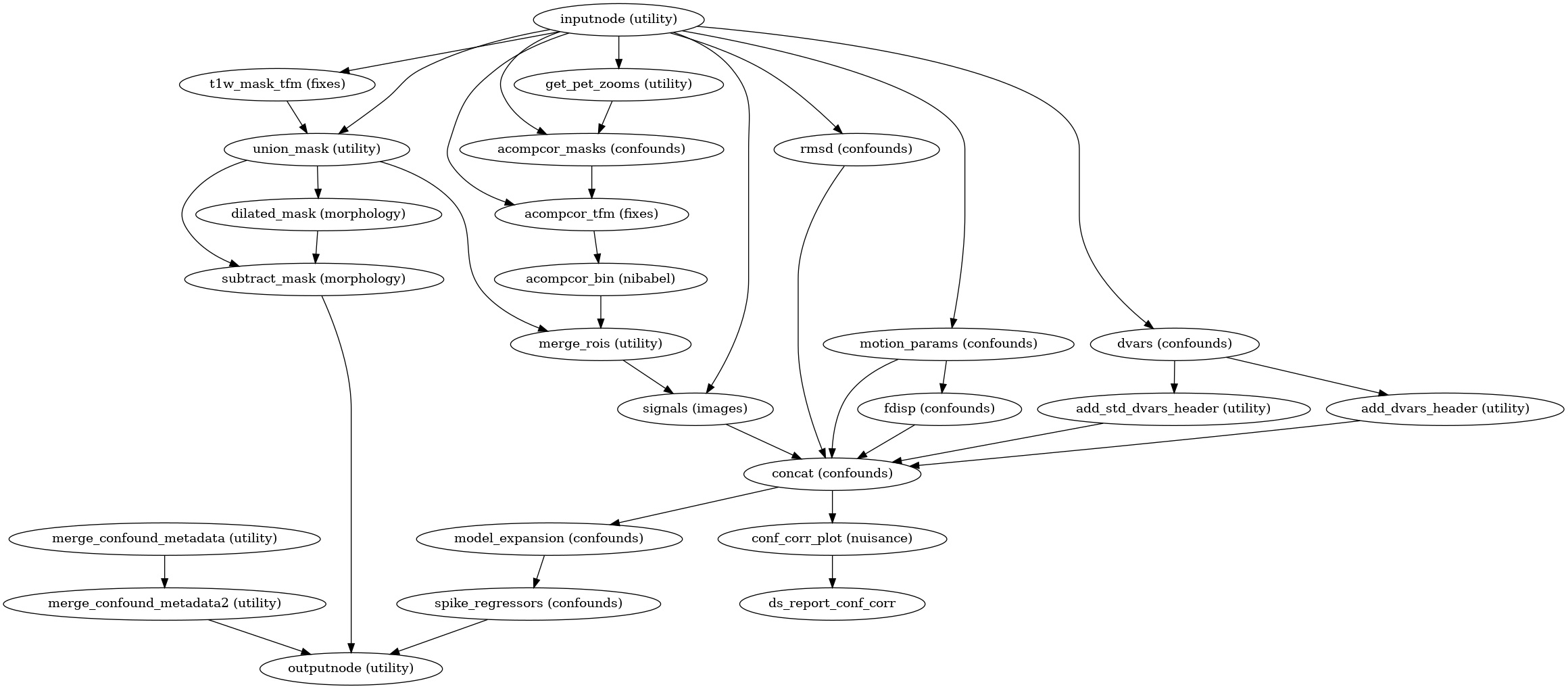
(Source code, png, svg, pdf)
- Parameters:
mem_gb (
float) – Size of PET file in GB - please note that this size should be calculated after resamplings that may extend the FoVname (
str) – Name of workflow (default:pet_confs_wf)regressors_dvars_th (
float) – Criterion for flagging DVARS outliersregressors_fd_th (
float) – Criterion for flagging framewise displacement outliers
- Inputs:
pet – PET image, after the prescribed corrections (STC, HMC and SDC) when available.
pet_mask – PET series mask
motion_xfm – ITK-formatted head motion transforms
t1w_mask – Mask of the skull-stripped template image
t1w_tpms – List of tissue probability maps in T1w space
petref2anat_xfm – Affine matrix that maps the PET reference space into alignment with the anatomical (T1w) space
- Outputs:
confounds_file – TSV of all aggregated confounds
rois_report – Reportlet visualizing white-matter/CSF mask used for aCompCor, the ROI for tCompCor and the PET brain mask.
confounds_metadata – Confounds metadata dictionary.
crown_mask – Mask of brain edge voxels
Segmentation workflows.
Helpers for FreeSurfer gtmseg outputs.